|
Dear Family and Friends,
TROOPS
Some months ago, one of our readers commented how severely Clinton
had cut our military. We, too, thought he was at the root of the
problem, but downsizing actually began with the 1989 Bush administration.
Even so, Clinton has whacked and chopped the armed forces like
mad machetes through sugar cane. To be fair, some of it has been
necessary.
In light of so much information, data, national secrets and technology
falling into foreign hands during the Clinton administration,
one could be forgiven for questioning national security, possibly
President Clinton's motives. This old joke might be clever if
there weren't so much truth in it.
CLINTON'S IDEOLOGY
1. Downsize military
2. Over-extend military
3. Allow nuclear secrets to be given to China
4. Annoy China
OUR SHRINKING MILITARY
In George H. W. Bush's defense, the Vietnam War was signed off
at the Paris Peace accord 16 years before. During those 16 years,
the ebb and flow of military personnel fluxed only a small degree
just in case the Cold War developed into something nasty - like
WWIII. In 1989, when the Cold War ceased, there seemed less reason
to keep 2.1 million troops on active duty.
Whether it was an act of good faith on President Bush's part or
a perceived lessened threat, or both, former President George
Bush gave the order to cut troops by 15%. However, Clinton picked
up the ball and stormed like a crazed running back for the end
zone, chopping here, cutting there, whacking it another 25%. With our national security flung over his shoulder like
a Hail Mary, this strategy must be redrawn before we lose the
game.
TRAIL OF TROOPS
Source: Military Personnel Historical Reports
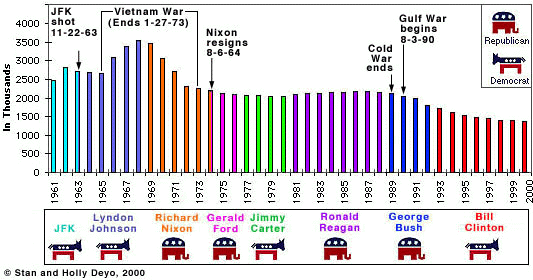
During the past four decades, the number of active US military
personnel peaked during the Vietnam War from 1965 - 1972. The
count stayed within ~114,000 troops for the next 16 years. We
turned the corner when the Cold War came to a close in 1989. Many
countries sloughed off the yokes of Communism, the Berlin Wall
came down and Germany reunited.
ACTIVE TROOPS IN LAST 40 YEARS
|
Year
|
Active Troops
(In 1000s)
|
Year
|
Active Troops
(In 1000s)
|
Year
|
Active Troops
(In 1000s)
|
Year
|
Active Troops
(In 1000s)
|
1961
1962
1963
1964
1965
1966
1967
1968
1969
1970
|
2483
2806
2699
2686
2654
3092
3375
3546
3458
3065
|
1971
1972
1973
1974
1975
1976
1977
1978
1979
1980
|
2713
2322
2252
2162
2128
2082
2075
2062
2027
2051
|
1981
1982
1983
1984
1985
1986
1987
1988
1989
1990
|
2083
2109
2123
2138
2151
2169
2174
2138
2130
2044
|
1991
1992
1993
1994
1995
1996
1997
1998
1999
2000
|
1986
1807
1705
1610
1518
1472
1439
1407
1386
1360
|
KennedyJohnsonNixonFordCarterReaganBushClinton
Source: Military Personnel Historical Reports
In the last decade, active troops have been cut by nearly 800,000.
CHANGE IN TROOPS FOR EACH PRESIDENT
Years As
Commander
-In-Chief
|
President
|
Troops Ending Previous Admin.
(In 1000s)
|
Troops Ending
This
Admin.
(In 1000s)
|
Net Change In Active Troops
(In 1000s)
|
Net
Change As
Percent
|
1961-1963
1963-1969
1969-1974
1974-1977
1977-1981
1981-1989
1989-1993
1993-2000
|
John F. Kennedy
Lyndon Johnson
Richard Nixon
Gerald Ford
Jimmy Carter
Ronald Reagan
George H. Bush
Bill Clinton
|
2475
2699
3546
2162
2082
2051
2138
1807
|
2699
3546
2162
2082
2051
2138
1807
1360
|
+224
+847
-1,384
-80
-31
+87
-331
-447*
|
+9%
+31%
-39%
-4%
-1.5%
+4%
-15.5%
-25%
|
In addition to heavy personnel cuts, the military has also suffered
decreasing numbers due to the surging economy and higher salaries
in the private sector. Veterans are being lured away and recruiting
offices are having trouble attracting enlistees. According to
the May 17th edition of USA Today, Selective Service registration is down. Every man living in
the U.S. is required to register for military service within 30
days of his 18th birthday, but just 83% of those turning 20 this year have complied. That figure is down from 90% just two
years ago. Most of the non-compliance is in Southern states among
immigrants and high school dropouts.
Low morale has also played a role. Whether it's politically correct
or not, the fact remains if given the choice, military personnel
would rather not see women and homosexuals among their ranks.
Add to that, their current Commander-In-Chief dodged the draft.
Clinton joined ROTC and then conveniently went overseas avoiding
the war. This does nothing for the morale of those willing to
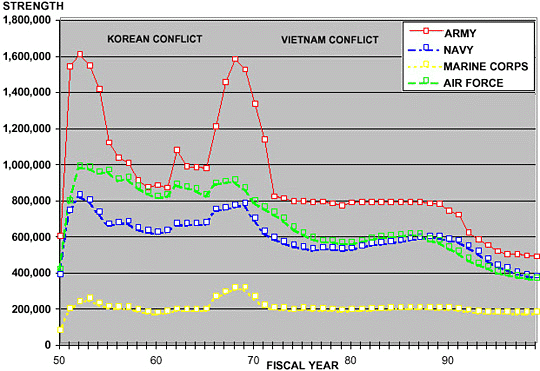
fight and die for our country. As a result of presidential cuts
and the above-stated reasons, troops numbers have shrunk. Only
the Marines have kept up their numbers during the last decade.
DoD ACTIVE DUTY MILITARY PERSONNEL 1950-19991
Source: DoD, Directorate of Information Operations and Reports
Yet while the number of troops has been cut, our military is deployed
more often. The Clinton administration dispatched troops into
peacekeeping operations in Bosnia, Haiti and Kosovo and these
deployments have stretched the military during a time when it
struggles to keep up recruiting and re-enlistment rates.
In order to quit stretching our active troops so thinly, it has
been suggested that greater reliance be placed on reserve forces.
It has also been suggested that our overseas presence could be
cut by 200,000 in Europe, Japan and South Korea. Third, rather
than using the military for humanitarian and disaster relief,
possibly other organizations could take over these areas. Last,
like most big groups (IRS for example) red tape and enormous piles
of paperwork strangle expediency. Red tape reduction would represent
a significant savings and this money, along with that saved from
BRAC (base closures), could be applied in other needed areas.
Continue
© Text and Graphics, 2000 Stan and Holly Deyo, except where otherwise
credited
|

