|
BASES
TRIMMING THE FAT
Base closings throughout the country is causing confusion. Some
see it as the government, once again, downsizing our defenses.
By close of 2001, there will have been four waves of BRAC - Base Realignment And Closures. With a lesser number of active duty personnel and the
Cold War behind us, all of these bases aren't necessary and they're
gobbling up dollars. Secretary of Defense Cohen stated, "The vast
sum that we are spending on unneeded facilities is robbing our
people of needed training, of weapons modernization, and quality
of life."
BASES TO BE CLOSED OR REALIGNED UNDER EACH ORIGINAL BRAC ROUND2
|
Major Base Closures
|
Major Base Realignments
|
Minor Base Closures or Realignments
|
Date Action To Be Completed
|
| BRAC I |
86 closures and realignments
|
59
|
Sept. 30, 1995
|
| BRAC II |
34 closures and realignments
|
48
|
Sept. 30, 1997
|
| BRAC III |
31
|
12
|
122
|
Sept. 30, 1999
|
| BRAC IV |
33
|
26
|
62
|
Sept. 30, 2001
|
Source: DoD
These four BRAC actions represent a significant savings which
can be applies to other areas of defense.
BRAC = SAVINGS
|
FISCAL YEAR '96 Figures (US$B)
|
|
Closure
Costs*
|
Total Projected 20
Year Savings
|
| BRAC I |
2.2
|
6.8
|
| BRAC II |
4.0
|
15.8
|
| BRAC III |
6.9
|
15.7
|
| BRAC IV |
3.9
|
17.8
|
* Excluding environmental costs and land sale revenues
BRACE FOR MORE BRAC
In looking at the expenditures vs. cost savings to close these
bases, it's easier to understand why these BRACs have been ordered.
Secretary of Defense William Cohen recommends yet another two
waves of BRAC.
"As a result of those four BRAC rounds, we have saved some $3.5 billion to date; we will save over $25 billion by the year 2003; and the reason that we need two more rounds of BRAC is that we expect to save some cumulative $20 billion total, and then $3.5 billion roughly, or $3 billion a year thereafter.
"Now that's $20 billion that can be used not only to go for additional
pay, additional weaponry, but also into the families. The military
families who desperately need additional assistance. They go pretty
much taken for granted."3
The Fiscal Year 2001 Federal Budget request calls for two additional
rounds of BRAC in Fiscal Years 2003 and 2005.
BRAC COSTS VS. SAVINGS
|
FISCAL YEAR 97 Figures (US$M)
|
|
COSTS
|
SAVINGS
|
|
6-Year Costs
|
Environmental Costs
|
6-Year Savings
|
Annual Savings
|
| BRAC I |
1,931
|
820
|
2,352
|
700
|
| BRAC II |
3,593
|
1,942
|
6,306
|
1,600
|
| BRAC III |
6,320
|
1,705
|
7,530
|
1,900
|
| BRAC IV |
3,600
|
550
|
3,900
|
1,600
|
Revising Fiscal Year 96 figures, DOD projects BRAC IV savings over 20 years at $19 billion and annual recurring savings from all BRAC efforts at approximately $6 billion.
(Source: Secretary of Defense Annual Report to the President and Congress, March 1996.)
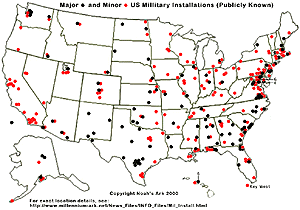
MILITARY BASE LOCATIONS
For exact location of military bases for the map on the right, click here.
In addition to the BRAC actions, Congress was asked to approve consolidation of laboratories, R & D and test facilities; reorganization of DoD's business practices; and elimination of reams of existing red tape. (Government in general would do well to undertake this last task!)
There is also a fine version of military base locations from the |
Click for larger view
|
Federation of American Scientists that can be downloaded in PDF. You'll need this accompanying index of numbered base locations to go with the map.
BUCKS
MILITARY BUDGET TIDBITS
- Except for a minuscule increase in 1992, the Pentagon's budget
has dropped every year since 1985.4 In fact, since 1985, it has dropped 40%.5
- Adjusted for inflation, defense spending has fallen every year
of the Clinton Administration so far from $298.4 billion in 1992
to $236.6 billion in 1998 (in 1992 dollars).6
- According to the CBO (Congressional Budget Office) report, it
will cost an average of $340 billion annually -- roughly $50 billion
above present levels -- to keep U.S. forces at their present size,
modernize their equipment, and maintain current readiness levels.7
- The Center for Strategic and International Studies figures the
Pentagon needs an extra $100 billion per year to maintain enough
force to fight two major regional conflicts simultaneously plus
handle several smaller contingencies.8
- Budget outlays for defense, even before taking inflation into
account, fell by $24 billion, from about $300 billion in FY 1990
to about $276 billion in FY 1999. (Fiscal years end September
30th.) This $24 billion decrease in defense spending compares unfavorably with the spending in
the three other broad categories of federal expenditures. From
FY 1990 to FY 1999, non-defense discretionary outlays rose from
about $200 billion to roughly $304 billion; interest on the debt
rose from about $184 billion to nearly $227 billion; and entitlements
soared from roughly $605 billion to about $959 billion. An aging
population will provide additional incentives for entitlements
in the coming years.
WHERE THE MONEY WENT 1990 vs. 1999
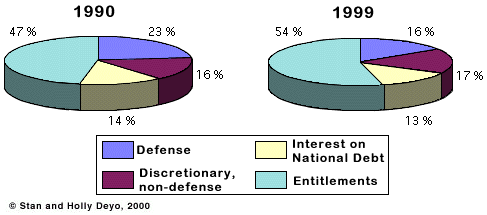
DEFENSE VS. OTHER FEDERAL SPENDING9
|
SPENDING IN BILLIONS OF CURRENT $$
|
| Area of Expenditure |
Fiscal Year 1990
|
Fiscal Year 1999
|
Change in $$
|
% Change
|
| Defense |
$300
|
$276
|
-$24
|
-8%
|
| Non-Defense Discretionary Spending |
$200
|
$304
|
+$104
|
+52%
|
| Interest on the Debt |
$184
|
$227
|
+$43
|
+23%
|
| Entitlements (freebies & social programs) |
$605
|
$959
|
+$354
|
+59%
|
Two different sources say we need between $50 and $100 billion
above the current budget to maintain U.S. forces at their present size, to modernize their
equipment, and to maintain current readiness levels. This brings
up the 1997 Quadrennial Defense Review - source of the Bush-touted-statement
that we're not ready to fight two large military conflicts at
once. The question is, is this much readiness necessary?
Chris Hellman, Senior Analyst for CDI (Center for Defense Information)
puts a different spin on our military budget and spending:
"First, 1985 represents the "highwater" mark of the Reagan era
military buildup, a buildup unprecedented in peacetime. Other
than the Korean War, military spending in 1985 was higher than
at any time since the end of World War II, exceeding even the
peak years of the Vietnam War. Even though there have been 13
straight years of cuts in annual military spending, we are only
just now getting down to the levels of the Carter Administration.
|
US Military Spending vs. The World for 2000 (Billions)10
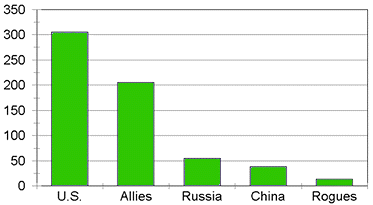
"Allies" refers to the NATO countries,
South Korea and Japan.
"Rogues" means Cuba, Iran, Iraq, Libya,
North Korea, Sudan, Syria.
|
Second, during the Reagan and Bush Administrations the U.S. national debt skyrocketed from around $829 billion in1979 to over $4 trillion in 1992. Meanwhile, while total global military spending has decreased from $1.6 trillion in 1985 to $797 billion in 1996, the U.S. share of the global military budget has increased from 30% to 33%."11
NOTE: In view of the devastating terrorist attacks against U.S.
embassies in Kenya and Tanzania in August, 1998, the budget includes
$1.1 billion for embassy security upgrades - almost 50% more than
the 2000 level. Good!
SOLDIERS' PAY
In 2000, dollars spent per soldier was $32,755.56. In 1999, it
was $31,192.26.12 The new budget includes a pay raise of 3.7%, which is a half percentage
point higher than the Employment Cost Index (Department of Labor's
civilian wage growth comparison) and 1.3% higher than the Consumer
Price Index. If we intend to recruit and keep good soldiers, their pay has to rise further, especially in light
of attractive private sector salaries.
Housing currently only covers 81% of expenses for military living
off base. About 19% ends up being "out-of-pocket" costs for military
personnel. The President's initiative lowers these costs to 15%
in 2001, and gradually eliminates all out-of-pocket costs by 2005.
Continue
© Text and Graphics, 2000 Stan and Holly Deyo, except where otherwise
credited
|

