.

Once Upon A Mighty Force
December 16, 2000
|
THE FUTURE
MODERNIZATION
- Military systems are being "modernized" by retiring older equipment
and not replacing it.30 Without budget increases, resources from other programs will have
to be robbed to purchase new equipment.31
- Planes, ships and tanks acquired during the Reagan administration's
buildup will begin to hit the end of their useful lives five or
10 years from now.32
- Procurements of new weapons could soar as much as 50% above this
year's $60 billion.33
- Analysts say Congress has contributed to the problem by refusing
to give President Clinton authority to close more than a dozen
unneeded military bases -- which could save as much as $5 billion
a year for modernization.34
LIGHTER-FASTER = BETTER?
To military experts, the term modernization often means lighter
equipment. That's because future conflicts will likely require
the U.S. to respond rapidly to developments in far corners of
the world. Lighter equipment facilitates rapid deployments.35
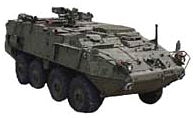
Photo courtesy US Army
|
Part of the modernization includes this new $4 billion wheeled
combat vehicle. The IAV (Interim Armored Vehicle), is not a substitute for the tank, but is a prototype
for a radically different combat vehicle - running on tires, not
tracks.
They had hoped the first combat team would be equipped with the
IAV by December 2001, but additional testing has set back the
schedule 16 months. By 2008, 2,131 IAVs should be in operation
and are expected to be used for the next 30 years.
Already research is underway for a combat vehicle the Army hopes
to have developed by 2010. |
Heavy tanks, which have been the Army's backbone for years, will
be upgraded. For at least the next decade, the IAV will be the
mainstay, not tanks. IAVs runs quieter and can transport a nine-man
infantry squad at speeds up to 60 mph.
Additionally, a newly established force called a "brigade combat
team" is being created to give the Army more quick-response capability
than it has ever had. The Army chose to invest in an interim solution
so that it could get started now on other much-needed other changes
in training and doctrine.
NOW THAT'S A GUN!
Even someone who isn't into firearms for either sport or profession
has to be impressed by a weapon that can effectively fire 1 million
rounds per minute. O'Dwyer's Smart Gun is electronically controlled
with multiple barrels and has an infinitely variable rate of fire,
with no mechanical moving parts, no opening breach and no movement
of ammunition from the magazine.
-
Along with a capacity to fire many times faster than existing
weaponry, the Smart Gun can be personalized to prevent unauthorized
use. Methods of personalization include palm or finger print recognition,
numerical code or magnetic swipe card activation, voice recognition,
and radio frequency activation.
Bullets are stacked like Life Savers |
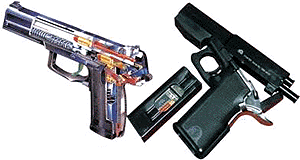 |
with explosive charges sandwiched in between. The charges are then set off when electrical contacts spark them in electronic sequence like how an
ink jet printer sprays ink.
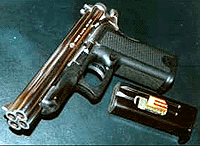
Police version of the Smart Gun
|
- While introduced June of '99, it received a major boost this year
from the DoD - specifically DARPA (Defense Advanced Research Projects
Agency). DARPA is funding US$10.25 million (AU$16.895 million)
for the development of a prototype Advanced Sniper Rifle utilizing
the Smart Gun technology. These dollars will support a three year
program to develop single and multiple barrel prototype rifles
for demonstration to the US military. If you want to read more
about the Smart Gun, see Metal Storm Limited's web site: http://www.odwyer-smartgun.com/
|
If all the handguns in America (76,000,000 by 1994 BAFT figures)
were replaced by Smart Gun technology, it would surely cut down
on black market sales and the urge for thieves to steal your weapon.
TURN AROUND FOR THE FUTURE?
'Walk softly and carry a big stick' always seemed like a good
defense strategy. If the bad guy feels he'll get squashed like
a militant mosquito, chances are he'll think it over carefully
before choosing to draw blood. I liked Ronald Reagan's "big stick"
policy. While some people put "the heavy" on Reagan calling him
"the actor", he always made me feel good about being American.
His infectious optimistic attitude and quick wit made one feel
anything was not just possible, but probable. It was a pleasant change from the constant shame felt every
year Bill Clinton has been in office. Everyone likes a robust
economy with the best unemployment record in 25-30 years of 3.9%,
but it's a high price to pay having people think Americans endorse
his moral character.
President Reagan believed in a strong defense and while President
Elect Bush has said nothing about increasing the number of troops,
he does question the number of overseas deployments and endorses
a strong national defense.
GEORGE BUSH ON DEFENSE
Supports deployment of a large-system scale national missile defense
system akin to Reagan's "Strategic Defense Initiative" and would
cancel the ABM treaty with Russia to do so.
Supports reducing the U.S. nuclear stockpiles to their "lowest
possible number" without sacrificing readiness or security levels
Would order an immediate review of overseas deployments, but maintain
long-standing U.S. commitments.
Supports an increase in defense spending, including a $1 billion
increase in military pay.
Supports spending an additional $20 billion defense R&D for post-Cold
War weapons systems to be developed between 2002 and 2006.
Opposes lifting ban on gays in military; supports current 'Don't
Ask, Don't Tell' policy.36
THIS YEAR'S DEFENSE BUDGET
For defense and the military, this is what's proposed for Fiscal
Year 2001:
"STAR WARS" NATIONAL MISSILE DEFENSE (NMD)
- $1.9 billion for National Missile Defense
- Total NMD funding for FY2001-2005 is $10.4 billion, $2.3 billion
more than last year's request.
BALLISTIC MISSILE DEFENSE (BMD)
Ballistic Missile Defense (BMD) is generally divided into two
major types of antimissile systems:
- (1) Theater Missile Defense (TMD), to protect U.S. troops abroad and our allies, including areas of
vital interest to the U.S. from relatively short- range ballistic missiles with ranges of
no more than 2,200 miles
- (2) National Missile Defense (NMD), to protect the U.S. "homeland" against intercontinental ballistic missiles with ranges beyond
2,200 miles
- The TMD mission includes protecting population centers, fixed
civilian and military assets and mobile military units.
The 2001 budget includes $4.7 billion for all BMD programs - an
increase of $657 million (17%) from 2000. We're spending half
again as much on missiles to protect our troops abroad and our
allies than the homeland which sounds reasonable.
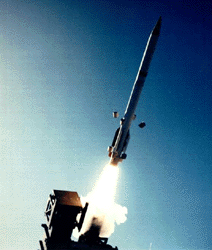
Besides money for purchasing the Patriot missiles, 90% of the
BMD budget is allocated for RDT&E - Research, Development, Testing
and Evaluation. The reduction of missile quantities in 2000-2001
is due to Congress reallocating $38 million from procurement to
RDT&E.
RDT&E covers all the work done to create new systems such as weapons,
sensors, or computers. This includes basic research on advanced
concepts and designing, engineering, or testing prototypes. |
 |
Fiscal Year 2001 Funding Request for Ballistic Missile Defense37
(Dollars in US Millions)
|
RDT&E
|
Procurement
|
Number
|
Total
|
| Total Ballistic Missile Defense (BMD) |
$4,180.1 |
$443.9 |
N/A |
$4,727.0 |
| National Missile Defense (NMD) |
1,740.2 |
74.5 |
N/A |
1,814.7 |
| Total Theater Missile Defense (TMD)* |
2,437.0* |
369.4 |
N/A |
2,808.3 |
| THAAD (TMD) |
549.9 |
---- |
0 |
549.9 |
| Navy Area Theater (TMD) |
274.2 |
---- |
0 |
274.2 |
| Navy Theater Wide (TMD) |
382.7 |
---- |
0 |
382.7 |
| Patriot PAC-3 (TMD) |
81.0 |
365.5 |
40 |
446.5 |
| MEADS (TMD) |
63.2 |
---- |
0 |
63.2 |
| Airborne Laser (TMD) |
148.6 |
---- |
0 |
148.6 |
| Space Based Laser (TMD) |
63.2 |
---- |
0 |
63.2 |
NOTES: * Not all systems being funded under the TMD program are shown.
The total given is for all TMD programs, not just those listed
here.
Continue
© Text and Graphics, 2000 Stan and Holly Deyo, except where otherwise
credited
|