|
DISASTER PREP FOR YOUR HORSE
Here are the supplies that you should have in a disaster kit for
horses. Adjust the amounts, depending on the number of horses
that you have.
FOOD
Since a horse's digestive system is very delicate, you should keep the horse on the same diet it is accustomed to during a disaster. Always have a reserve supply of the type of food or special feed your horse is used to eating that would last at least one week. Store feed in an airtight, water proof container and rotate feed at least once every three months. Include with your disaster supplies an extra feeding bucket, "just in case".
WATER
When the water supply is disrupted during a disaster, it can become
a real challenge getting enough water to give to a horse, and
dehydration can become a major problem for a horse, especially
when stressed. Try to keep at least two 50 gallon barrels for
each horse. You know the rest of the drum. Store water in a cool,
dark location, and be sure to rotate it so it remains fresh. Include
with your disaster supplies an extra water bucket; just in case
the one normally used is lost. |
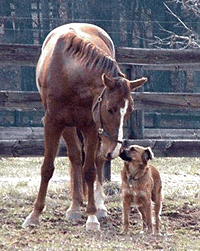
Photo by Todd Rowe
|
SANITATION
Maintaining a clean environment for horses during a disaster will
minimize the threat of disease. Keep at least a two week supply
of dry shavings or straw for your horse's stall. Keep a spare
pitch fork in case the one you usually use is broken or lost.
An extra wheelbarrow or muck bucket would not go astray.
IDENTIFICATION
It is important to have some type of identification on your horse
during a disaster such as microchipping, tattoos or freeze branding.
If your horse isn't permanently Identified consider one or more
of these ideas:
- Use a livestock crayon to write your name, phone number, and address
on the horse
- With clippers, shave your name, address, and phone number in the
horse's coat
- Braid into the horse's mane an I.D. tag with your name, address,
and phone number on it.
- Keep a spare I.D. tag with your disaster supplies. If you're housed
somewhere temporarily, you can write that phone number and address
on the extra tag and braid it into the horse's mane;
- With your disaster supplies, keep current photographs of you standing
with your horse to prove ownership;
- With your disaster supplies, keep a copy of the Bill of Sale for
your horse or other documentation to prove ownership.
FIRST AID KIT
Check with your vet to find out what else he/she recommends you
include in your first aid kit. Suggested items include:
|
|
cotton and cotton rolls
disposable surgical gloves
vet wraps
duct tape
telfa pads
Betadine
instant cold packs
easy boot
diapers
Furazone
|
scissors
Blue Lotion
tweezers
two seek supply of any prescription your horse
is currently taking
|
With your horse's disaster supplies, keep your his Coggins certificate
and all medical records including dates of shots. It's important
to keep your horse up-to-date on vaccinations, especially tetanus,
since the risk of getting cut during a disaster greatly increases.
EVACUATING YOUR HORSE
In case you have to evacuate your horse, you should have a horse
trailer and a truck to pull it. Be sure to periodically check
the trailer's safety including its floor, trailer hitch, tire
and lights.
If you don't have a trailer or one large enough to evacuate all
the animals, then have prearrangements in place for transporting
your horse(s) and where to take them. If these accommodations
don't include a barn, you'll need a leather halter and lead cotton
rope for each horse. Nylon for either of these items melts too
easily. Before a disaster occurs, train your horse to tether so
he feels comfortable. Any animal stressed does not need surprises.
Temporary housing might include equine centers, boarding stables,
racetracks, and fairgrounds. It's fair to say evacuation of larger
animals requires more time. They'll already be skittish sniffing
disaster and if they aren't very familiar with their trailer,
loading may require more time than you have. During the emergency
is not the time to convince a horse who has never been in a trailer
to venture inside.
BUBONIC PLAGUE THREAT
As we mentioned earlier, prairie dogs abound in many parts of
Colorado and in other states as well. There's no doubt they're
cute perched atop the burrows, but in truth, they can be a menace.
Not only do they attract snakes who view prairie dogs as "dinner",
but they also use these burrows as their home. These four to six inch wide holes are no small thing especially
in your front yard. Horse owners must be very wary of them since
their horses can easily stumble in them breaking a leg.
For the last two evenings on the nightly news, there have been other warnings -bubonic plague. These little critters can be infested with fleas carrying this disease. Several carcasses tested positive last year and due to the reduced prairie dog activity this year, the country health department suspects bubonic plague again.
Rabbits can also become infect and both go back to their burrows
to die.
This potentially life-threatening disease, can be spread easily
to humans through contact with fleas that infect rodents. The
most common method of transmission is via pets that bring infected
fleas into a home.
|

Photo by John White
|
The County Heath Department recommends the following tips to avoid contact with infected fleas:
1. Do not allow pets to roam at large beyond your yard.
2. Insecticide powders or shampoos should be used on pets every
few days. The effectiveness of flea collars has not been proven,
but if used, they should be changed every month or two.
3. Do not linger in rodent-infested areas.
4. Do not catch, play with or attempt to hand-feed wild rodents,
including rabbits.
5. Eliminate potential rodent hiding places such as piles of lumber,
broken cement, trash and weeds.
6. Make sure homes and outbuildings are as rodent-proof as possible.
Keep foundations in good repair and eliminate overhanging trees
from roofs and windows.
7. Avoid contact with all sick or dead rodents and rabbits.
8. Look for the presence of blow flies or foul odors as evidence
of animal die-offs.
9. Cats infected with plague sometimes exhibit swelling and sores
around the mouth, head and neck.
10. Seek veterinary care and do not handle a suspected sick pet
without gloves and face protection.
11. Anyone experiencing unexplained symptoms within two to six
days (the incubation period of plague) of possible exposure to
fleas should see a doctor.
COMET DOES THE SPLITS
A group of astronomers using the 1.5-meter Catalina telescope report that the nucleus of comet C/2001 A2 (LINEAR) has split into two pieces. Just a week ago was whole! The comet's brightness has soared to 100 times compared to what it was at the end of March. Scientists think this is due ti volatile ices in the fragmenting nucleus being newly exposed to solar radiation.
Right now the comet is just below naked eye visibility. No one
knows how much the comet will brighten as it heads for a 0.78
AU close encounter with the Sun on May 24th. This comet has no chance of impacting Earth.
This week, sky watchers in the Southern Hemisphere with modest
telescopes or binoculars can spot the fuzzy, fragmenting snowball
from the outer solar system near the feet of Orion after sunset.
|
010422.gif)
Photo © Tim Puckett, 2001
Click for a bigger view
|
The chart below should help locate Comet Linear A2 (red circle).

WIth affection,
Holly and Stan,
Seismo and Taco
Seismo: "Taco!... I think I've gained a new sense. I can sense an emergency coming my way!"
Taco: "Stick to your sense of smell, Seisy. It's much more reliable!"
Seismo: "I'm serious, Taquita! I just heard our Mom and Dad talking about the newsletter. They said they had ZERO dog food left in our emergency supplies!!!"
Taco: "Hmm.m.m.m.mmm... Yes, to anybody who's glued to his food bowl, I can see how that sounds like an emergency. . ."
Sources:
Plague Suspected in Pueblo West; May 3, 2001; http://www.chieftain.com/thursday/news/index/article/3
Stan and Holly Deyo
In Colorful Colorado!
http://millennium-ark.net/
© Text and Graphics, 2001 Stan and Holly Deyo, except where otherwise
credited
|

010422.big.jpg)