|
Your (Un)Friendly Terrorist: Who's Got What?
NUCLEAR PROLIFERATION

The map above shows current nuclear stockpiles as of 1998.
Global unease grew significantly with both India and Pakistan developing more advanced nuclear weapons and they are only moments away from full deployment capability. Tensions between India and Pakistan have been only a click away from war over Kashmir that certainly could have turned nuclear.
Iran also aspires to have nuclear weapons and Iraq has not given up the bomb despite a decade of sanctions and inspections.
North Korea is still a large factor even though they froze Pyongyang's ability to produce additional plutonium at Yongbang.
An article in the World Tribune two days ago reported that more than 100 terrorist groups have now "succeeded in obtaining elements for the construction of a nuclear bomb".1 Materials were obtained from nuclear reactors in the former Soviet Union. Many of these terrorist groups come under the leadership of FBI fugitive Osama Bin Laden who's thought to possess at least two bombs of his own.
This United Nations report stated that 550 incidents of nuclear trafficking have been recorded since 1993 and that worldwide smuggling of radioactive materials has doubled since 1996.
With the plethora of information on the Net, anyone with access to a computer has access to entire manuals for making homemade explosives -- TNT, plastic, napalm, including plans for building triggers, fuses, and timers. At least a dozen online vendors offer books with recipes on biological or chemical weapons, including Silent Death and Kurt Saxon's The Poor Man's James Bond. Some information on chemical and biological agents is available too. The problem is further exacerbated by the fact that many chemicals used to make nerve gas and other agents have perfectly legitimate uses and are readily available.
TERRORISM BY TYPE
Cuba, Iran, Iraq, Libya, North Korea, Sudan, and Syria are the seven "rogue states" the U.S. Secretary of State has designated as state sponsors of international terrorism.
U.S. policy is to pressure these states to cease their support by applying a broad range of sanctions, both unilateral and multilateral.
International cooperation is essential in making these sanctions work, and more needs to be done in this area.
With all these weapons just waiting for a twitchy finger, a communications snafu, religious zealots or other extremists, not to mention an unhinged individual bent on revenge, do we dare rest easy? |
 |
YOU LITTLE BEAUTY!
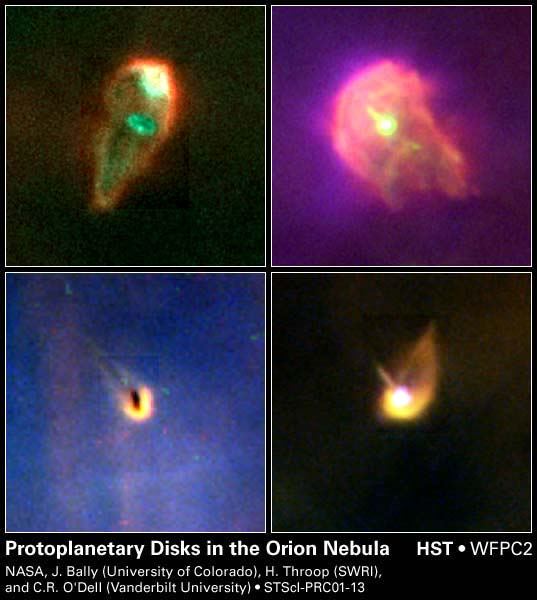
Eventually, if they are lucky, these little beauties will grow into planets. New pics from Hubble are giving astronomers their first direct visual evidence for the growth of planetary "building blocks". By looking inside the dusty disks of young stars in the Orion Nebula, they're seeing them as a giant "star factory" near Earth.
|
These snapshots also reveal that the disks are being "blowtorched" by a blistering flood of ultraviolet radiation from the region's brightest star, making planet formation extremely difficult.
These building blocks start as tiny particles no larger than snowflakes or gravel. The particles (pictured right) have now grown 1,000 times in size. This is quite a feat considering that one astronomer compared the planet-building process in Orion to constructing a skyscraper in the middle of a tornado.
"Planet infants" in Orion Nebula
Larger view of these disks
|

|
THE WORLD'S IN A WHIRL
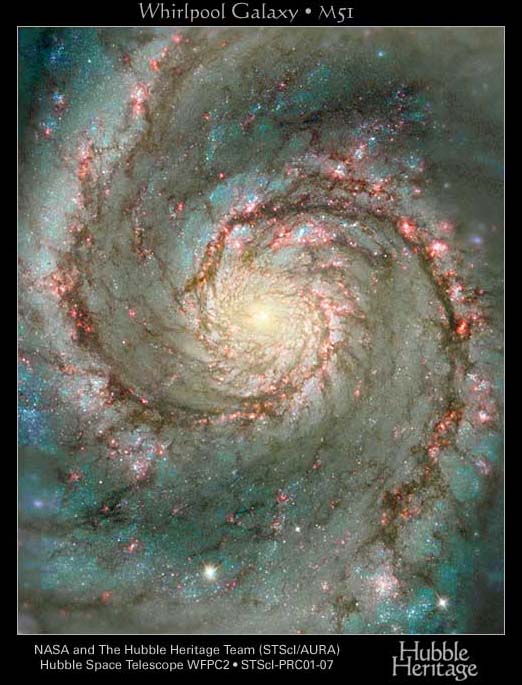
More pics from Hubble telescope gave astronomers a detailed view of the Whirlpool Galaxy's spiraling arms and dust clouds. What's exciting here? This is the birth site of massive, luminous stars.
Whirlpool, also known as M51 and NGC 5194, is having a close encounter with a nearby companion galaxy, NGC 5195, just off the upper edge of this image. NGC 5195's gravitational pull is triggering star formation in Whirlpool, which is seen in brilliant detail by numerous, luminous clusters of young and energetic stars. The bright clusters look red due to the light emissions from glowing hydrogen gas.
This Hubble photo reveals new information with an unprecedented view of Whirlpool's intricate spiral arm structure. Astronomers are seeing dust "spurs" along the arms that branch out almost perpendicular to the main spiral arms. The regularity and large number of these spurs suggests that the popular theory of a spiral galaxy having only two arms needs revamping. This image also shows a dust disk in the center of Whirlpool which may feed a black hole.
|

Larger view of Whirlpool Galaxy
|
With affection,
Holly and Stan
Seismo and Taco
Stan and Holly Deyo
In Colorful Colorado!
http://millennium-ark.net/
© Text and Graphics, 2001 Stan and Holly Deyo, except where otherwise
noted
Sources:
1 100+ Terrorist Groups Have Nuclear Bombs Or Components; May
17, 2001; http://www.worldtribune.com/worldtribune/breaking-8.html
"The Worldwide Threat in 2000: Global Realities of Our National
Security", Statement of George J. Tenet,
Director of CIA before the Senate Foreign Relations Committee;
March 21, 2000
Weapons of Mass Destruction in the Middle East; http://cns.miis.edu/research/wmdme/index.htm
Carnegie Endowment for International Peace; http://www.ceip.org/programs/npp/Numbers/numbers.htm
Counter-terrorism; http://www.emergency.com/
Internation Security Affairs; http://www.lib.umich.edu/libhome/Documents.center/ps472.html
Center for Nonproliferation Studies; Monterey Institute of International
Studies; http://cns.miis.edu/
|