| . |
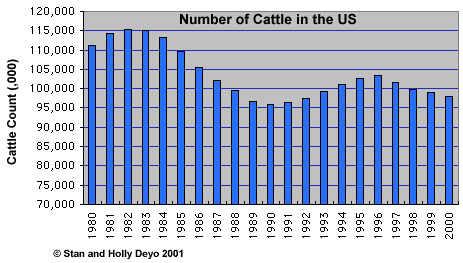
While beef production is up from 21,469,000 pounds in 1980 to
26,000,000 pounds in 2000, the actual number of cattle raised
decreased. In 1980, US herds totaled 111,000,000 head, but fell off 12%
in 2000 to 98,000,000. So you'd think profits would be down, yes?
Source: National Cattlemen's Beef Association http:www.beef.org,
USDA & Cattle-Fax
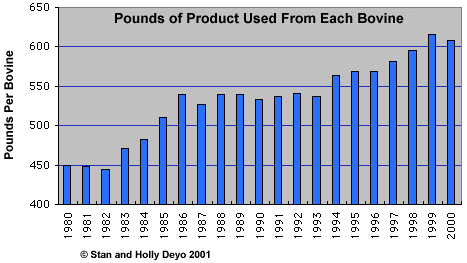
Here's the interesting thing. Though there's less cattle, each
bovine is actually producing more of everything. In 1980 each animal produced about 449 pounds
of usable items. This includes hide, tallow, meat and everything
else used from the animal. Two decades later, each bovine was
a better "producer" providing 608 pounds of sellable goods. Animal
raising techniques have improved and their food's quality certainly
must have too! Don't know that humans can say that.
By 2000, consumable beef products in America were valued at $54.8 billion in retail dollars! That makes the beef industry very heavy hitters
indeed.
Source: National Cattlemen's Beef Association http:www.beef.org,
USDA & Cattle-Fax
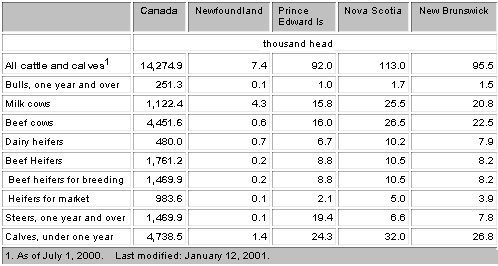
Canada also has very sizable cattle herds. For any of these countries'
herds - Canada, Australia, the United States - to become BSE-
infected would be nothing short of devastating.
Source: Statistics Canada, CANSIM, matrix 1150 and Catalogue no
23-603-XPE
BUCKING AT BATTERED BRITISH BEEF
By November 2000, beef sales in France had plunged by 40% in three
weeks and 30% in Spain. The panic didn't stop there and spread
to Italy, Belgium, and beyond.3 Consumer beef confidence urgently needed to be restored throughout
the EU which prompted all cattle over 30 months to be tested for
BSE.
This week beef sales in Germany dropped by 50% since the discovery
of tainted meat4 and down 27% in the European Union as a whole.5 On Monday, the EU estimated the mad cow crisis across Europe would
cost about $1 billion and possibly jeopardize other agricultural
programs.6 Consumer confidence has sunk to new depths and in order to restore
it, the EU is prepared to slaughter and incinerate up to 2 million
more head of cattle by the end of June 2001.
The ban on MBM (Meat and Bone Meal) will also boost demand for
U.S. and South American soymeal, much of which is genetically
modified. Alexander Doring, secretary-general of the Brussels-based European
Feed Manufacturers' Federation (FEFAC) stated, "This measure will
raise the costs of feed production substantially". He forecast
a 10-15% increase in European demand for soymeal to substitute
for MBM plus costs for industry and farmers of two billion euros
($1.73 billion) a year due to the use of more expensive vegetable protein alternatives.7
"Around $1.3 billion-worth of feed is produced in EU countries
every year, and destroying it would cost about double that amount.
Finding replacement feed would add another $595 million to the
bill."8 And the dollars keep ticking. . .
TROUBLE IN BURGER LAND
 McDonald's arches were knocked on their golden ear this week when they released their latest earnings report. For the first time in 2-1/2 years, the world's largest fast food chain saw a decrease in earnings. The 9% drop was blamed squarely on Mad Cow fears in Europe. McDonald's arches were knocked on their golden ear this week when they released their latest earnings report. For the first time in 2-1/2 years, the world's largest fast food chain saw a decrease in earnings. The 9% drop was blamed squarely on Mad Cow fears in Europe.
Sales were hardest hit in France, Germany, Spain and Italy. Britain
has now gone through two such sales dips. When Mad Cow first came
into British limelight in 1996, McD's sales slumped then as well.
WHERE TO PUT IT
When literally thousands of cattle had to be slaughtered, a practical
question came up. Where do all the carcasses go? People and business
that were already operating on a shoestring began to carelessly
dispose of these disease-infested bodies, if they disposed of
them at all.
In Spain, 300 cattle were found rotting at the bottom of an unused
mine in the northwestern Galicia region, where the majority of
the country's mad cow cases have been discovered.
In Ireland, cattle were indiscriminately buried by water sources
too close to the water table and in areas prime for flooding.
Two months ago, right during massing flooding in the UK, it was discovered that 13 barrels of BSE waste had been stored at a chemical plant damaged by an explosion. Before the explosion, this plant had been hit twice by flooding. Just as the Severn River was expected to flood that weekend, six barrels of BSE waste turned up missing. Where'd the six BSE barrels go? Two answers become obvious. Either they exploded with the rest of the toxins that rained down on the residents or the floated away in the first two floods.
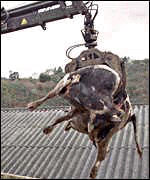
Ireland came up with a bright solution. They dumped the dead BSE
cattle down copper strip mines and sprinkled them with lye. That sprinkle of lye was absolutely worthless.
According to Dr. Ron Brown, in order for sodium hydroxide to be
effective against prions, it must be in very high concentration.
For each one pound bucket of contaminated BSE waste, 400 grams
(~ one pound) of lye must be used to disable prions. Let's see,
for an average 600 pound (272 kg) cow, it'd take 272 kg or 600
pounds of sodium hydroxide. Don't think a "sprinkle" quite got
the job done.
The cull of all cattle aged over 30 months which has cost more
than £2bn (US$2.9 billion) since introduced in 1996, has created
a 460,000 tonne (506,000 tons) mountain of meat and bone meal. So how do you dispose of all
these cattle responsibly?
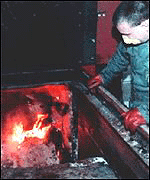 Britain is using some of these carcasses for electricity. When
so many bovines had been slaughtered, their carcasses started
piling up everywhere. Even with a capacity to burn 85,000 tonnes
(93,500 tons) of a year, one plant can't keep up with the new
waste material produced and two more furnaces are expected to
come on-line. In order to meet Environmental Agency standards,
the plant could not allow anything to escape into the atmosphere
and each cow must be subjected to at least 850oC (1562oF) for a minimum of two seconds.
Britain is using some of these carcasses for electricity. When
so many bovines had been slaughtered, their carcasses started
piling up everywhere. Even with a capacity to burn 85,000 tonnes
(93,500 tons) of a year, one plant can't keep up with the new
waste material produced and two more furnaces are expected to
come on-line. In order to meet Environmental Agency standards,
the plant could not allow anything to escape into the atmosphere
and each cow must be subjected to at least 850oC (1562oF) for a minimum of two seconds.
To give you an idea how much it costs to dispose of bovines, this
is how it stacks up:
|
Disposal Method
|
Cost per 100 pounds
|
Cost per Ton
|
|
Average
|
Range
|
Range
|
| Burial |
$1.50
|
--
|
$30
|
| Landfilling |
$1.90
|
$0.55 - $3.25
|
$11 - $65
|
| Incineration |
$3.13
|
$2.50 - $3.75
|
$50 - $75
|
| Treated as Medical Waste |
$10.00
|
--
|
$200
|
RENDERED USEFUL?
It's not just the beef-food industry that reaps megabucks from
bovines. There are also milk and milk products, leathergoods,
medicines, cosmetics, clothing, shoes and a seemingly endless
list of goods that add literally billions of dollars to the economy.
One business we don't often consider which turns a hefty profit
is rendering.
Someone loses a pet and it is not retrieved for burial by the
family. We see dead animals magically scooped from the roads and
highways to keep them pristine. After those nice filet mignons
are consumed, what happened to the rest of the animal? Hmmm, what
did happen to that cow and all the rest of the dead animals?
Most often they end up at a rendering plant. It is a necessary
business to dispose of many, many millions of dead animals each
year. America annually rakes in $2.4 billion from processing 40
billion pounds of dead animals a year.
Continue
© Text and Graphics, 2001 Stan and Holly Deyo, except where otherwise
credited
|