| . |
TELL IT LIKE IT IS LYMAN
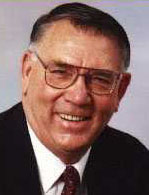 According to Howard Lyman (pictured right), rancher and author of Mad Cowboy, "there is simply no such thing in America as an animal too ravaged
by disease, too cancerous, or too putrid to be welcomed by the
embracing arms of the renderer. Another staple of the renderer's
diet, in addition to farm animals, is euthanized pets - the six
or seven million dogs and cats that are killed in animal shelters
every year. The city of Los Angeles alone, for example, sends
some two hundred tons of euthanized cats and dogs to a rendering
plant every month. Added to the blend are the euthanized catch
of animal control agencies, and roadkill." (Roadkill is not collected
daily, and in the summer, the better roadkill collection crews
can generally smell it before they can see it.)"9 According to Howard Lyman (pictured right), rancher and author of Mad Cowboy, "there is simply no such thing in America as an animal too ravaged
by disease, too cancerous, or too putrid to be welcomed by the
embracing arms of the renderer. Another staple of the renderer's
diet, in addition to farm animals, is euthanized pets - the six
or seven million dogs and cats that are killed in animal shelters
every year. The city of Los Angeles alone, for example, sends
some two hundred tons of euthanized cats and dogs to a rendering
plant every month. Added to the blend are the euthanized catch
of animal control agencies, and roadkill." (Roadkill is not collected
daily, and in the summer, the better roadkill collection crews
can generally smell it before they can see it.)"9
After this putrid mixture has been ground and steam-cooked, the lighter, fatty material floating to the top is refined and used in cosmetics, lubricants, soaps, candles, and waxes. The rest, as we read in Part 1 of Moo Madness, is dried, pulverized and turned into animal feed called "protein concentrates". This amounted to cannibalism when fed to most ruminants. Cows were being fed dead cattle, sheep, goats and anything else dead that was tossed into the cooking vat. These protein concentrates - "enriched" animal feed - fattened livestock. The other name for protein concentrates is MBM - the infamous Meat and Bone Meal which has been banned from many ruminants' feed. Some countries like Australia still feed livestock ground-up dead horses, dogs, cats, pigs, chickens, and turkeys, as well as blood and fecal matter of their own species and that of chickens.
As a result of what this fourth generation dairy farmer and cattle
rancher discovered about the rendering industry and disgust that
he was forcing his own animals into cannibalism, Howard Lyman
revolted and became president of the International Vegetarian
Union.
COWBOY BOOTS AND LAWSUITS
 About now you might be scratchin' your chin, thinkin', hmmm, where have I heard that name. Howard Lyman... Howard Ly -- I've got it! He's that guy who was on Oprah (pictured right) and they got into a pot o' trouble! Now if you were thinking that, you'd be right. About now you might be scratchin' your chin, thinkin', hmmm, where have I heard that name. Howard Lyman... Howard Ly -- I've got it! He's that guy who was on Oprah (pictured right) and they got into a pot o' trouble! Now if you were thinking that, you'd be right.
It was April '96, Howard Lyman called Oprah and asked to be on her show. He wanted to share about a number of issues affecting our food supplies, not the least of which were E.coli, Mad Cow and rendering practices. During the course of the show, when Lyman went into some detail about cow cannibalism, Oprah blanched visibly vowing, "It has just stopped me from eating another burger!" I remember that show vividly thinking at the time, this was really disgusting news.
From that day and for the next two weeks, cattle prices dropped steadily before rising again due to what cattlemen referred to as "the Oprah crash". Cattlemen were furious. They sued Oprah, Harpo, her production company, King World Productions and Howard Lyman. Oprah claimed she had the right to mull over health possibilities on her show through freedom of speech. The cattlemen retaliated claiming Lyman had spread falsehoods severely damaging their business.
One Amarillo cattle feeder Paul Engler was livid and claimed he
had lost $6.7 million because of the show. When he and a dozen
other cattlemen sued, their claims of falsehoods told were groundless
as 20 people had already died of CJD in Britain. After a five-week
trial, Oprah and Lyman were exonerated winning their case right
in the heart of cattle country - Amarillo, Texas.
ROADSIDE DINER
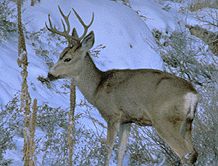 With fair regularity, I'd see dead dear along the roads in Colorado. On windy roads, it can be difficult to see more than 100 feet ahead and these fleet-of-foot beauties dart in front of vehicles faster than you can say "Jack Rabbit!" With fair regularity, I'd see dead dear along the roads in Colorado. On windy roads, it can be difficult to see more than 100 feet ahead and these fleet-of-foot beauties dart in front of vehicles faster than you can say "Jack Rabbit!"
This isn't just occurring in the mountains either. After being
hunted to zero in some states and their total numbers shot down
to 1/2 million, white tails became a protected species. In recent
years, the deer population has exploded across America. It's estimated
that 25 million deer now roam through the US and collide with
500,000 vehicles yearly. Photo: White-tailed Deer
Many perish and a significant number may remain roadside for several
days. For a variety of birds and animals and other deer (cannibalism again), it's a veritable feast, and yet
another way to spread CWD.
By virtue of lesser numbers, the 250,000 elk in Colorado fare
a little better for personal encounters with vehicles.
TOO CLOSE TO HOME
Mad Cow and its related forms first caught my attention in 1994
when living in Colorado. A family friend was mad for hunting -
no pun intended. Whatever was in season: deer, duck, rabbit, goose,
elk, Rick hoped he'd be granted a hunting permit for that season
and he never came home empty-handed. During off-season he fished.
Rick is nothing if not a skilled outdoorsman - a craft he's passed
onto his son. Besides being an excellent shot, he performed his
own dressing, butchering and sausage making and Rick always shared
his bounty with us. On numerous occasions, he'd bring over venison
steaks and German sausages made from an old family recipe. Prepared
properly, most wild meat lost its "gamy" taste and it was an interesting
change from beef, chicken and fish.
After reading about Chronic Wasting Disease (CWD), Rick shot through my mind and I asked him what he
thought about it. He claimed he'd heard the scuttlebutt, but wasn't
overly concerned. That was seven years ago and it seems to be
the prevailing attitude of many hunters today. Considering CWD
is found in greatest concentrations in Colorado right where we
lived and where Rick hunted in southern Wyoming, I'm surprised
he was so casual about it.
CHRONIC WASTING DISEASE IN COLORADO
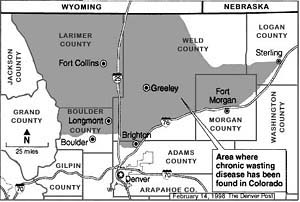 This graphic from The Denver Post, February 14, 1998 shows where CWD is heaviest in Colorado. This graphic from The Denver Post, February 14, 1998 shows where CWD is heaviest in Colorado.
"In the wild and especially out west, chronic wasting disease is spreading fast. Northeastern Colorado documented its first case in 1981. By the mid-1990s, samplings of mule deer brains showed 3% to 4% testing positive for CWD. Within a few years, the rate was 8%, and now Larimer County, the center of the endemic area, has a 15% rate of infection among mule deer. It's also being found in deer and elk in Wyoming"10, Montana, Nebraska, South Dakota and Oklahoma and on elk ranches
in Saskatchewan. Iowa, Illinois, Texas, and Wisconsin all had
cases of CWD traced back to an infected herd from Nebraska.11 Altogether, 10 states now have CWD whether in elk, deer or both: Colorado, Wyoming, Wisconsin, New Mexico, South Dakota, Nebraska, Montana, Kansas, Oklahoma, Minnesota, and Canada.11.5
"Fifteen percent of a wild population of animals with this disease is staggering," says Dr. Thomas Pringle, who tracks CWD-type diseases for the Sperling Biomedical Foundation in Eugene, Ore. "It's basically unheard of." Moreover, he adds, "this is an unusually virulent strain... with highly efficient transmission mechanisms."12
"CWD has moved between adult animals at game farms, leading scientists
to conclude that it can be spread through saliva or simple contact."13. It has yet to be proved and may only pertain to animals kept
on game farms.
However, if game farms are high risk for CWD, states like Wisconsin
which has approximately 100 deer or elk farms stand to lose big
business. "On the Internet, prices for elk calves start at $1,500,
and breeding bulls go for up to $20,000. Some farms sell venison
and the velvet that peels from new elk antlers (considered an
aphrodisiac in Asia). Others offer "hunts" costing between $1,000
and $5,000 for trophy deer, to more than $10,000 for bull elk
with massive antlers."14 Regardless of the financial implications, a more aggressive surveillance
and testing system desperately needs to be put in place.
Distribution of Chronic Wasting Disease in the States (through 9-14-02)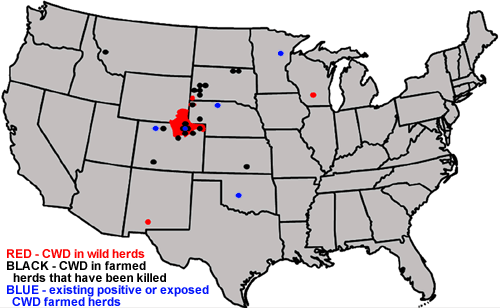 Source: http://www.aphis.usda.gov/ Source: http://www.aphis.usda.gov/
DEYO NOTE: CWD is also in Saskatchewan and Alberta, Canada
WHO'S THE PREY?
This hunter's story from The Denver Post sharply illustrates the need for faster and better CWD testing. "It's got me worried. It's got me down to the point where I won't be meat-hunting in that area any more."
Chris Melani of Longmont had hunted in Larimer County for more that 20 years and shot a deer two years ago that tested positive for chronic wasting disease.
Melani said he followed all the requirements outlined by the Colorado Division of Wildlife and was instructed to wait three weeks for notification on his venison. No call. He had to wait an additional three weeks before they notified him that his deer was infected. By then he and his family had eaten some of the meat. The rest of the venison Melani took to a meat processing company, where it was mixed with hundreds of other deer meat and made into sausage. How many dinners plates and BBQ grills did this CWD-infected venison visit?
"You know they said to wait three weeks, so three weeks went by and I went ahead and ate it," he said. "Next time I'll wait longer."15
'Six weeks after turning in the head, Melani learned his deer was among forty that had tested positive for CWD last season. "They said it was okay," he says. "They weren't going to tell anyone else about it."'16
For every "aware" hunter like Chris Melani, you get dozens and dozens who are taking zero precautions. Arnold Hale, a retired hunting outfitter from Livermore, Colorado stated, "Around here, people are not knowledgeable about the disease or just don't care. When you talk to hunters, most don't trust the government. I don't know anyone taking precautions."17
Another typical response came from 28-year-old Kurt Zunker, a probation officer from Cheyenne, Wyoming and avid hunter. "I'm aware of the situation but not really abreast to the
complete ramifications of it. It won't stop me from hunting."18
MISLED AND MISFED
The map below shows where Colorado is divided by the Division of Wildlife into hunting units for this year. Each "game management unit" is assigned a particular number and is divided by county lines, natural boundaries, highways, rivers and so on.
In 1997, thirteen units in Colorado had diseased deer: 7, 8, 9, 18, 19, 20, 91, 92, 93, 94, 95, 96 and 191 and then hunters were required to submit game heads for chronic wasting disease tests. Units 9, 191, 19 and 20 show the highest concentration of sick animals with #9 being the absolute worst. Nothing has changed. Colorado still has at least 15% of their deer herds infected with CWD in these areas, yet this year, there is NO MANDATORY game testing. This is tantamount to telling the hunter, "OK, go ahead, eat your kill. It's safe. No worries." Areas shaded in gray and yellow have voluntary testing for CWD.
-
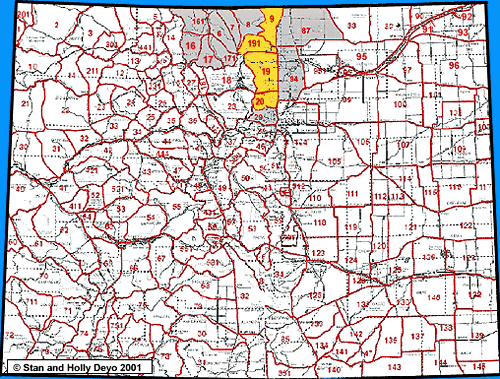
Last Saturday, the Denver Rocky Mountain News came out with an article entitled "Hunt Takes Aim At Wasting Disease" on the front page of their on-line paper. It stated that 290
special mule deer licenses have been issued to hunters this year.
The aim is to reduce the 1000 strong deer herd by half - where
CWD is worst - in an area between U.S. 287 and I-25, Fort Collins
and the Wyoming state line." This is game unit #9 on this map.
- Another article on the Colorado Department of Wildlife site "Tests Confirm Wasting Disease Has Not Spread" (January 16, 2001) gives off a casual air of 'no big deal'.
The impression is that the number of deer infected is only 5%.
Only further down in the article is mentioned the 15% number.
If hunters don't read the entire article and take "CWD has not
spread" to mean "it is therefore going away", plus see that they
aren't required to have their game tested for disease, they might assume a faint
"all clear" has been sounded.
HUNTER WARNING BELIES NONCHALANCE
This is simply not the case. In the body of the article, after
reading that testing is voluntary only and the usual play down that there is no BSE in America and assurances
that "it appears that there is a good biological barrier between
the transmission of CWD between deer and cattle", the hunter gets
these vital warnings:
"The Division continues to recommend that hunters not take animals
that appear to be sick no matter the cause. Animals that appear
to be diseased should not be consumed." They also recommend that
the "brain and nervous tissue of deer and elk not be consumed."
"Hunters who field dress game animals should wear protective gloves, especially if they have open cuts or wounds on their hands.
They should also carefully wash knives and other tools used to field dress game." (Deyo note: Fat lot of good washing
their knives will do since even harsh disinfectants don't faze
prions! And the bit about "open cuts and wounds" certainly suggests
transmission by blood.)
"Miller said hunters have reported a number of animals that appear
to be sick. Most have been ill with other diseases such as hemorragic
disease and other bacterial or viral infections, injuries or old
age. "If hunters, landowners or others see ill animals, they should
report them to the local Division office," Miller said." (Mike
Miller is the Division's veterinarian.)
It is only in the very last paragraph that you read during November
2000 the Wildlife Commission approved a special late hunting season
for unit 9 "to reduce the incidence of chronic wasting disease."
Does that sound like it's under control and not a problem? Saying
the disease has not spread more likely means the diseased animals
have not migrated into other game units. It can not and does not say that the number of CWD-infected deer has decreased.
Another vet at the Colorado Department of Wildlife in Fort Collins,
Dr. Mike Williams, made a most irresponsible statement on Halloween
2000 saying there was no need to close off the most high risk
areas to hunters. "We don't think the problem is a big deal. If
people choose to hunt there, it is their choice."19
Continue
© Text and Graphics, 2001 Stan and Holly Deyo, except where otherwise
credited
|