|
March 10, 2001
Setting the Nuclear Stage and Protecting Yourself
DON'T BE DOWNWIND
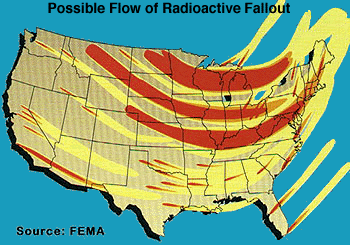
The mapping system above gives a general idea for the path of radioactive material, but it doesn't take into account change of wind direction or wind speed. Both have a huge role where the radioactive "sand" is carried. Lighter winds cause it to be deposited more broadly and not as deep. Stronger breezes make the fallout "plume" narrower and travel further.
Other factors influence where radioactive material lands include type of |
|
nuclear fuel used, the bomb's design, whether it's an air burst or impacts Earth's surface, geography around the target, whether it's hot or cold, hazy or clear, night or day.
HOW MUCH IS TOO MUCH?
Before we get in a real panic, let's take a look at how much radiation
we'd have to be exposed to before we get in real trouble.
Radiation Doses in Perspective (in millirems*)
|
DOSE
|
REACTION
|
|
450,000 - 800,000
200,000 - 450,000
60,000 - 100,000
10,000
5,000
700
500
400
100
70
60
40
30
20
10
8
7
6
3
1
|
Half Die Within 30 Days
Hair Loss, Severe Blood Changes, Some Death in 2-6 Weeks
Radiation Sickness Possible
1 in 130 Risk of Cancer
Annual Occupation Limit
Nuclear Brain Scan
Apollo XVI Astronauts
Annual Dose From Natural Background
Annual Limit for the Public
Annual Terrestrial Dose in Denver
Annual Dose From Medical Exams
From Your Body
Annual Cosmic Rays
Annual Terrestrial Doses in Maryland
Transpolar Flight
Annual Dose From Building Materials
One-Week Dose in U.S., All Sources
Chest X-Ray
Transatlantic Flight
Leg or Arm X-Ray
|
* unit of measurement used to describe dosages of radiation. The
average person is exposed to
about 360 millirems per year from naturally occurring radioisotopes
and medical procedures.
Source: Nuclear Regulatory Commission
WARNING
Generally speaking, if Russia aimed a nuclear warhead at us and
let her rip, it would arrive in about 40 minutes. Providing the
government let the public know immediately (what are the chances of that or the likelihood you hear the warning
when first aired?) you might have 30 minutes to get your act together.
This is another reason why maintaining your preparedness supplies,
especially stored water, is smart.
SHELTER
Blast, light, heat and radioactive fallout are all potential problems.
Distance is the best preventative medicine, but should an explosion
occur close to you, adequate shielding is a must. If you have
the means and desire to build a regular fallout shelter, several
good places for free information are Cresson H. Kearny's Nuclear War Survival Skills and Bruce Beach's You Will Survive Doomsday. Your emergency broadcast system should instruct you to go to
a specified safe building or you may choose to stay at home for
a variety of reasons.
It goes without saying that being outside offers no protection
from the direct blast, intense heat, blinding light or flying
debris. According to Canada's pamphlet, 11 Steps to Survival being inside your home, in an interior hallway with no windows
offers slight protection. If you have a basement with a stairwell and can access
the area under it, it provides fair protection. The best solution is having a special blast shelter.
To be truly protected, meaning screening out 99% of radiation,
one would have to take definite and purposeful steps to provide
this type of protection. General recommendations for true safety
would require the following precautions for a shelter:
- 16 inches (40 cm) of solid brick
- 16 inches (40 cm) of hollow concrete blocks filled with mortar
or sand
- 2 feet (61 cm) of packed earth - 3 feet (1 meter) if loose
- 5 inches (12.7 cm) of steel
- 3 inches (7.6 cm) of lead
- 3 feet (1 meter) of water3
The reality is most of us will not have the means, time or motivation
to build it, so now what.
AFTER THE BLAST
The main concern will be radioactive fallout. It usually looks
like light-colored, small grains of dust, sand or grit. Look on
smooth surfaces like the hood (bonnet in Australia) of a car to
spot it.
Two rules of thumb for fallout generally hold true, but not for every instance:
1. The greater the density, the greater the hazard.
2. For every seven fold increase in time, radioactivity decreases
ten fold. For example, after seven hours, fallout has lost about
90% of its strength one hour after the explosion. After two days
it has lost 99%; in two weeks 99.9% of its strength is gone.
This does not mean we are safe at this point because even 0.1% could be dangerous.
Radiation can not be seen or smelled, and not felt until after
the damage is done. Long hours of exposing vital organs to low
levels of radiation can be fatal in just a few days so wait for
a statement from officials before venturing outside.
SYMPTOMS
There is a lot of confusion about what happens after exposure
to radiation. Assuming most of us survive, what might we expect?
Let's assume we appear uninjured though probably we are in a great
deal of shock. Hopefully we were far enough away from the blast
and protected to be healthy. If not, symptoms may be mild and
pass with little drama. If severe, depending on the type of radiation,
dose received, and rate of exposure, symptoms can include weakness,
loss of appetite and hair, vomiting, diarrhea, tendency to bleed,
inflammation of the mouth and throat, and increased susceptibility
to infection. Vomiting and diarrhea can also result from stress
so don't panic if you experience this.
In severe cases of exposure, death occurs within a few days to
four weeks. Those who survive six weeks after exposure to a single
large dose of radiation to the whole body generally recover.
Radiation sickness is NOT contagious! You can't get sick by helping those who have been
exposed.
WHAT'S HAPPENING? - WHO KNOWS?
The good news is most people will survive unless they are simply
too close to the bomb blast. It's a pretty safe bet, though, most
things will be in chaos and "normalcy" as we know it will have
ceased for the time being. For starters, electricity probably
won't be functioning and now would not be a good time to venture
outside to start your generator. This is when having back up power
that can be activated from indoors is clever. A good supply of
flashlights, candles and matches would be helpful, along with
propane heaters/indoor cookers.
Everything is relative and how close you and public utilities
were to the blast governs what is still functioning. You may or
may not have television or radio. Having a crank type or short-wave
radio would be a big plus. Chances are the ordinary citizen is
not going to have a dosimeter (instrument for measuring radiation)
to see if it's safe to go outside so most people will have to
rely on the all-clear from authorities.
WATER
Water will be safe if it is in covered containers, comes from
covered wells or undamaged water systems. For people who collect
water via roof catchment, it will be necessary to thoroughly wash
the roof collection surfaces before the next rain washes particles
into the storage containers. Given sufficient warning a strike
is imminent, disconnect the downspout which funnels the water
into your storage tanks. Contrary to popular belief, water does
not become radioactive. Using chlorine bleach or boiling water
will do nothing to get rid of radioactive elements; they only
kill germs and bacteria. Water can be filtered to remove most
fallout. (See Chapter 8 of Nuclear War Survival Skills.)
Be sure to have stored a minimum requirement of water. This means
at least 1 gallon (4 liters) drinking water only per person per day. You will need to factor in extra water for
hygiene purposes. In crisis times like a nuclear attack, I wouldn't
even worry about water for laundry and dishes and conserve water
for absolute necessities. Consumption heads the list! Don't forget
to store food and water for pets. They too will need to be inside
to survive. Dare To Prepare has an entire chapter devoted to pet preparedness ideas and requirements
for any emergency not found on our web site.
FOOD
First, clean the kitchen removing any fallout grit and thoroughly
wash all surfaces. Make sure your hands and under the fingernails
are clean after touching any contaminated surfaces and before
handling food.
Most food will be fine to eat especially if it has never been
opened or is in sealed cans. Foods which have been previously
opened like grains and cereals should be examined carefully to
see that no fine particles have slipped into the packaging. Foods
with "jackets" like bananas, peanuts, apples and peaches should
be washed and then removed before eating.
Before opening any food product, wash the containers in a stream
of water so no contamination is accidentally introduced into the
package. There is not a lot of radiation at this point that can
cause you harm, but the key is not to ingest any contaminated particles. It can build up in internal organs and
bone marrow.
Like with any disaster, expect to not have electricity, and this
time, not being able to cook on the BBQ grill since it's outside.
It may also be that you are unable to get to your generator which
further limits cooking abilities, unless there is an indoor activation
switch. This means you will need a minimum two week supply of nonperishable food. Depending on whether or
not you have a camping stove or a Volcano cooker, both of which
can safely cook food indoors, means many foods may have to be
consumed as-is. A few Heater Meals and MREs could provide warm
meals with a minimum of fuss. You will find sources of each here.
One unavoidable problem is the issue of gardening and foods we
eat further down the food chain. For example, cows eat grass which
may be full of contamination and in turn, we drink their milk
or eat the meat. With each successive link in the food chain,
radiation is concentrated, not lessened. When eating meat, it
is best to avoid cuts where radioactive materials concentrate:
thyroid glands, kidneys, liver, meat next to the bones and bone
marrow.4
Our initial thought of growing our own food may not work if the
soil is radioactive. Crops that have not been harvested and survive
the blast will take radioactivity into their plant structures.
When we eat them, we will be consuming contaminated food. Radiation
from a nuclear blast is not the same as nuclear waste that hangs
around for many years. Depending on how much radiation your growing
soil took in, it should be suitable within a year for crops again,
but it should be tested first. This process can be expedited by
replacing the topsoil. For more information on this topic, see
Duncan Long's Getting Food After a Nuclear War.
HYGIENE
Preparing for this type emergency is similar to preparing for
any other disaster minus the luxury of being able to go outside,
probably for several weeks. This means all toilet activity will
have to be completed inside using little or no water unless you
have a huge supply stored. Even then we would be hesitant to waste it on
toilet business. Instructions for making indoor compost toilets
and bucket toilets can be found in Dare To Prepare. These work well for substitute toilets in times of no electricity,
are very inexpensive, quick to make and require no water.
Be sure to have a plentiful supply of good quality, heavy duty trash bags for waste, used paper plates/cups, food containers,
empty cans, bottles, or dirty diapers. Plan enough trash sacks
for double bagging as this is no time for gagging odors, rips
or spillage to escape.
In the final article of this series we will take a look at who's
got what goodies. Thankfully the world is at a Mexican standoff.
. . for the present.
With affection,
Holly and Stan
Seismo and Taco
|
|
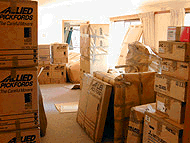
Formerly Deyo House, now
Chaos House |
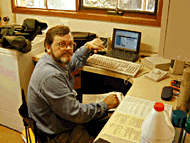
Stan's new office - in the laundry!
"Hey, hon, put a load in, will ya?"
|
"Hey Taco, do you think The Parents remembered to pack dog food?
"Dunno Seis, personally I'm looking forward to people food! Besides
we've got more to worry about than lunch. Haven't you noticed
all our stuff keeps disappearing? Yesterday it was our mats and
beds. This morning our food bowls. . ."
"I know Tac, and I've stuck to The Parents like a second skin
all week. Just like we agreed - one of us always has to be on
lookout."
"I don't get it Seis. Thought Mom and Dad were happy here. I know
we were - swimming in the dam every day, chasing birds, snakes
and mice. . ." (Taco stops abruptly)
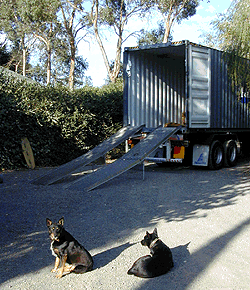
"Hey Seis, don't look now, but four of those mover guys just picked
up our doghouse er, uh, outside domicile!"
|
|
"Buggah! Taco, this is serious! What if they drop it?"
"This is seriously GOOD! Seismo"
"Huh?"
"Gee, ya big goof! Why would they take the doghouse without the
dogs??"
"That cinches it! We're going too! But just in case, you watch
one direction and I'll watch the other. That way all the bases
covered."
"Gee, being a watchdog is tough work!"
Stan and Holly Deyo
http://millennium-ark.net/
© Text and Graphics, 2001 Stan and Holly Deyo, except where otherwise
noted
Sources:
1Questions Surround 60 Minutes Suitcase Nuke Report; Steve Macko; ERRI Risk Analyst
2Jim Bramlett, PLO Reported To Have Nukes, August 20, 2000
311 Steps to Survival; Canada Emergency Measures Organization, Department of National
Defence, Blueprint for Survival
No. 4. The Queen's Printer, Ottawa, 1969; http://www.webpal.org/survival/books/11Steps/index.htm
4Getting Food After a Nuclear War; Duncan Long; http://www.zoomnet.net/~grsc/bible/nuke.html
11 Steps to Survival; Canada Emergency Measures Organization, Department of National
Defence, Blueprint for Survival No. 4. The Queen's Printer, Ottawa, 1969; http://www.webpal.org/survival/books/11Steps/index.htm
Recommended Reading:
You Will Survive Doomsday; Bruce Beach
Potassium Iodide Dosage, Shelf Life and Sources
Nuclear Weapons FAQs, Carey Sublette
11 Steps to Survival
|
