|
BUCKS (Cont.)
LOSS OF EQUIPMENT
Aircraft. For 1998, the number of combat aircraft fell 434 or 4.8%. Sixty-two
airlift planes were also retired, and 857 other aircraft. In total,
1,353 planes were taken from service, reducing the number of aircraft
available by 6.6%.13
Ships. From 1992 through September 2000, the Clinton administration
reduced the number of ships from ~393 ships to 316 in the fleet. During 1998, more than 10% of all submarines were decommissioned,
reducing the total to 123 from 137 the year before. Ten support
ships were lost along with 684 small boats. Overall, U.S. ship
strength was reduced 16%.14
Combat vehicles. The number of tanks was reduced 827 or 7.6%. Other combat vehicles
fell 6,360 or 14.5%. Overall, available combat vehicles declined
by 13.1%.15
HIGH COST OF DOING WAR
These stats put into perspective just how costly war can be in
financial terms. We already know how awful it is in human terms.
Dollars flit out of fist like lemmings over a cliff.
- Cruise missiles fired from ships and submarines run $1 million
a piece, and those launched from B-52s cost twice that.16
- A laser-guided 2,000 pound bomb dropped from a radar-evading F-117
costs $26,200, while an unguided bomb from a B-1 or B-52 runs
about $600.17
- To fly a B-52 -- the most expensive of the craft used in the Yugoslav
war -- cost $8,300 for one hour. Costs for other craft range down to $1,740 an hour for an F-117. To fly that same craft from Missouri to the Balkans, a trip that
took 31 hours, cost $5,719 an hour.18
- The Pentagon reported the Yugoslav bombardment cost $37 million
a day, not including relief operations. This contrasts sharply to the
44-day Persian Gulf War which cost a total of $61 billion.19
- Because the Air Force did not plan ahead -- as did the Army and
the Navy -- ordering night-vision goggles for its pilots in the
Yugoslav war ended up costing $7,000 a set.20
- After a four-year study, the Brookings Institute found that from
1940, the U.S. has spent $5.48 trillion through 1996 (in 1996
dollars) on nuclear weapons. Here's the real shocker. Only 7%
of that $5.48 trillion went for actual development and manufacture
of the warhead. A whopping 86% went for deployment equipment (bombers
and missiles) and the infrastructure to facilitate their use.
The majority of the remaining 7% went to cleanup.21 As an aside, this expense roughly corresponds to the national
debt which ticked off $5,707,111,759,932.43 owed as of November
24, 2000. That's $20,6779 of debt for every American.
- The Quadrennial Defense Review called for the purchase of 4,000
aircraft, specifically the F-22, the F/A-18 E/F, and the Joint
Strike Fighter. That buying spree tallies an estimated $350 billion.22
FINANCIAL CUTBACKS
- Personnel shortfalls have reportedly forced the Pentagon to drop
two Army divisions -- 12,000 to 22,000 soldiers each -- from its
combat-ready list.23
- Maintenance is falling way behind. Backlogs have grounded one
out of four Air Force fighters.24
- Navy ships are setting sail with fewer sailors aboard.25
- From tanks to bombers to helicopters, the armed forces' hardware
is aging fast and wearing out.26
DEPLOYMENTS
YOU CAN BE TOO THIN!
The pace of military deployments has increased 16-fold throughout
the 1990s. According to Representative Curt Weldon (R-PA), the
Clinton Administration deployed U.S. forces 34 times compared
to 10 deployments during the entire 40-year period of the Cold
War.27
- "Between 1960 and 1991, the Army conducted 10 operations outside
of normal training and alliance commitments, but between 1992
and 1998, the Army conducted 26 such operations. Similarly, the
Marines conducted 15 contingency operations between 1982 and 1989,
and 62 since 1989. During the 1990s, U.S. forces of 20,000 or
more troops were engaged in non-warfighting missions in Somalia
(1993), Haiti (1994), Bosnia (1996), Iraq andKuwait (1998)"28 and Kosovo (1999).
|
 |
It's expensive maintaining personnel overseas. For 100,000 troops
stationed in Europe as opposed to within the U.S., the coffers
are drained $1-2 billion annually. Direct costs of maintaining
them overseas - including pay and benefits, operation and maintenance
of units, and military construction pegs $9.8 billion annually.
Add in the indirect costs - including equipment repairs, transportation
costs, etc., a percentage of overhead expenses, and a share of
the cost of the weapons, the annual number leaps to $50 billion.29
WHERE ARE OUR TROOPS NOW?
Our troops are currently stationed throughout the world.
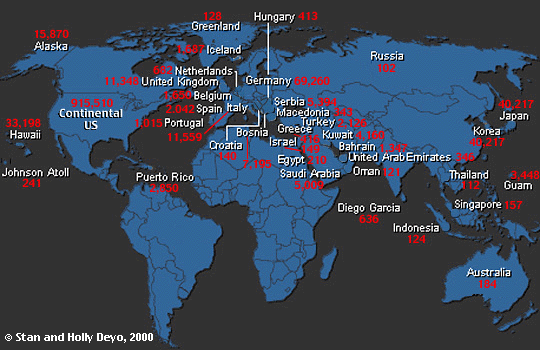
Source: CNN
The cost of our involvement worldwide for being the "world's policeman"
(who appointed us this task anyway!) is extremely expensive. We've
paid - literally - for the high cost of war, intervention and
peacekeeping. We've paid in wear and tear on equipment and most
importantly, we've paid in soldiers' lives.
This is not to say we should become isolationists, but the "America
First" policy has its appeal.
Stan and I did not vote for Pat Buchanan, but we have to agree
with him that our price of involvement around the world is too
high. During his acceptance speech of the 2000 Reform Party's
nomination he made the following statement. "We do not want to
isolate America from the world, but we will no longer squander
the blood of our soldiers fighting other countries' wars or the
wealth of our people paying other countries' bills."
Continue
© Text and Graphics, 2000 Stan and Holly Deyo, except where otherwise
credited
|

